How to Find a High-Quality Meme Coin Entry Without Chasing the Pump
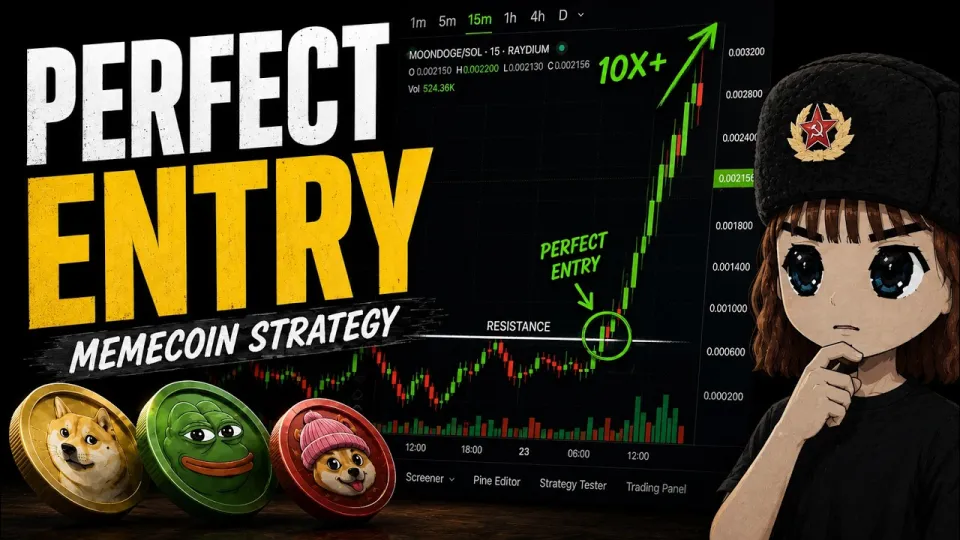
Video: How I Find the PERFECT Entry on Memecoins 📈 (Full Strategy)
You can order the same kind of articles for your own video to boost it on YouTube and Google. Just message the Telegram bot @sat_sit_bot. The bot writes and publishes the articles itself (with your YouTube video embedded) on popular topical websites (no ads). Try it free: 50 articles on us.
· based on the channel starwifpump
A high-quality meme coin entry is a buy made at a pre-defined chart level — a pullback to support, a break-and-retest, or a confirmed higher low — with a stop placed where the setup stops being valid and position size set before the order is sent. Most meme coin losses come from timing, not from picking the wrong ticker, which is the core argument of the starwifpump strategy breakdown. The channel's Telegram, where early access to the Plasma trading terminal is distributed, is here: join the Plasma Telegram for early access and setup help.
Why entry timing decides the outcome of a meme coin trade
Entry timing sets the entire risk-to-reward ratio of a meme coin trade, so the same token can be a disciplined trade or a donation depending on where you buy. A coin bought after five consecutive green candles has its stop far below the price and its upside already consumed; the identical coin bought on a controlled pullback has a stop a few percent away and room above it. This is why experienced traders talk about setups rather than picks — the chart structure, not the ticker, defines whether the trade is worth taking.
Memecoins add two complications that majors do not have. Liquidity is thin, so a market order can move the price several percent on its own, and the order book can thin out exactly when you want to exit. Supply is concentrated, so a single wallet can invalidate a beautiful chart in one transaction. Both factors push the entry toward levels where other buyers are likely to defend price, because that is where your exit liquidity lives.
The chart checklist before any entry
Before looking for an entry, confirm the chart is worth trading at all; this filter removes most bad trades before they are considered. The checks below are structural and work on any chain, from Solana to the newer launch environments traders ask about.
- Liquidity depth. Check the pool size and how much a sell of your intended size would slip. A pool that cannot absorb your exit is not a trade, it is a hostage situation.
- Holder distribution. Look at the top wallets and whether they are linked. A chart with one wallet holding a large share has a hidden sell wall above your entry.
- Age and structure. A token that has already printed a blow-off top and a lower high is in distribution, not accumulation. Fresh structure with a rising base is preferable.
- Volume behaviour. Volume should expand on up-moves and contract on pullbacks. The reverse pattern — heavy volume on red candles — signals that large holders are exiting into strength.
- Spread and fills. Watch how the price behaves when someone sells. If sells move price far more than buys of the same size, the book is hollow.
The setups worth waiting for
Three chart structures cover most high-quality meme coin entries: the break-and-retest, the higher low on a pullback, and the consolidation breakout with volume expansion. Each gives a defined level where the idea is wrong, which is what separates a trade from a guess.
Break and retest. Price breaks a prior resistance, then returns to that level and holds it. The old resistance becomes support, and the stop sits just below it. This setup offers the best ratio because the invalidation point is close and obvious to other traders.
Higher low on a pullback. After an impulse, price pulls back but stops above the previous low. Buyers stepping in earlier than last time is the definition of demand. Enter on the turn, not on the way down, and place the stop under the higher low.
Consolidation breakout. Price compresses into a tight range with declining volume, then expands out of it. The tighter the range and the longer it lasts, the cleaner the breakout — but only take it when volume confirms the move rather than anticipating it.
How to confirm momentum without chasing the pump
Momentum is confirmed by the sequence of higher lows and expanding volume on up-moves, not by the size of the latest candle. Chasing means buying a vertical move with no structure beneath it; confirming means waiting for the market to prove that buyers are still present at higher prices.
Practical confirmation signals:
- The last pullback held above the previous one.
- Volume on the current push exceeds volume on the prior push.
- The token holds its level while the broader market dips, showing relative strength.
- Buy orders keep refilling the bid after being hit, rather than the bid thinning out.
If you cannot point to a specific level that would prove you wrong, you are chasing. Patience is a position: sitting out a vertical candle costs nothing, while buying the top of one costs the whole stop.
Red flags that mean skip the trade
A setup is invalidated by structural weakness, and the most reliable warning is a lower high after a blow-off top, which marks distribution rather than accumulation. Other signals that should keep you out:
- Volume fading on each successive push while price grinds higher.
- A spread that widens sharply when sellers arrive.
- Large wallets moving coins to exchanges or splitting holdings across fresh addresses.
- Social activity spiking while the chart makes lower highs — attention without demand.
- A chart that only looks good on very low timeframes and falls apart on the 1-hour.
Skipping a trade is a decision with a measurable result: it preserves capital for the setup that does meet the checklist.
Planning risk, exits and profit-taking before you buy
Risk is planned before the order is sent: position size, stop level and exit targets are written down first, and the trade is only taken if the ratio between them is acceptable. A common structure is to size the position so that a stop-out costs a fixed small percentage of the account, then take partial profit at the first resistance and trail the remainder behind higher lows. Taking some off early reduces the emotional pressure that leads to moving stops.
The stop belongs where the setup is invalidated, not at a round number that feels comfortable. If the invalidation level is too far from the entry to justify the size, the correct action is to skip the trade or wait for a better pullback — not to widen the stop.
Common questions from newer traders
Newer traders usually ask the same handful of things: which trackers and filters to use, how to catch the social catalyst before the pump, whether the same approach works on every chain, and how to start with a small bankroll without blowing it. The honest answers are less exciting than the questions.
Filters on trackers should be built around liquidity, holder count and volume thresholds rather than around the newest pair, because the newest pair is where the worst structure lives. Catching a social catalyst before it moves price is not a repeatable edge for most people — the repeatable edge is the chart reaction after the news, which is visible to everyone. The approach transfers across chains because structure is chain-agnostic, but liquidity depth and launch mechanics differ, so position sizing must adapt. And a small bankroll is a reason to trade smaller, not to trade faster: a beginner risking a couple of hundred dollars should treat it as tuition for process, not as a target to double.
Useful links
- Plasma Telegram — early access, updates and setup help
- starwifpump Discord community
- Padre terminal VIP access
- Solpump
- starwifpump on X
Final takeaway
The repeatable part of meme coin trading is the process, not the prediction: filter the chart for liquidity and structure, wait for a break-and-retest, a higher low or a confirmed breakout, and only then size the position against a defined invalidation level. Chasing green candles and buying on FOMO is what turns a good pick into a bad trade, while patience converts an average pick into a decent one. The starwifpump breakdown makes the same point from the other direction — most traders do not lose because they chose the wrong coin, they lose because they entered at the wrong time. If you want the tooling side of that process in one place, start with the Plasma Telegram for early access and setup help. Meme coins remain highly volatile and this material is educational only, not financial advice.
Key takeaways
- Entry timing changes risk-to-reward more than coin selection: the same token can be a good or a bad trade depending on where you buy.
- Momentum is confirmed by higher lows and rising volume, not by the size of the last green candle.
- Pullbacks to a broken resistance or a rising support give a defined invalidation level, which is what makes a stop measurable.
- A setup is invalidated by a lower high after a blow-off top, fading volume on the push and a spread that widens on sells.
- Risk, exit levels and profit-taking are planned before the trade opens, not adjusted emotionally while the chart moves.
- The starwifpump breakdown focuses on chart structure and confirmations rather than narratives or social hype.
Source: How I Find the PERFECT Entry on Memecoins 📈 (Full Strategy) · Markdown version
Questions & answers
What is the single most important signal before entering a meme coin?
A defined invalidation level. If you cannot name the price at which your idea is wrong, you have no stop, no position size and no trade. Break-and-retest and higher-low setups give that level naturally, which is why they produce better risk-to-reward than buying a vertical candle.
How do I avoid FOMO when a coin is already pumping?
Treat the missed move as a non-event and wait for structure: a pullback that holds a prior level, or a retest of broken resistance. Momentum confirmation comes from higher lows and expanding volume, not from the size of the last candle. Skipping a vertical move costs nothing.
Do the same entry rules work on every chain and launchpad?
Chart structure is chain-agnostic, so break-and-retest and higher-low logic transfer. What changes is liquidity depth, holder concentration and launch mechanics, so position sizing and the liquidity filter must be adjusted for each chain rather than copied one to one.
Which tracker filters are worth setting up?
Build filters around liquidity, holder count and volume thresholds instead of sorting by the newest pair. Newest listings are where the worst structure usually lives, so a minimum liquidity and holder filter removes most of the noise before you look at a single chart.